Exploring a new category of clinical insight systems
Project Snapshot
Mentalyc
AI-powered clinical co-pilot for therapists
2025
Product Strategy & Design Consultant
Product strategy, AI system design, UX
Product leadership, UX research, Engineering, Clinical advisors
Strategic Insight
Most digital mental health platforms focus on documentation and administration.
However, every therapy session contains rich conversational signals about:
- Therapeutic alliance
- Symptom patterns
- Treatment progress
These signals are rarely captured by existing tools.
This project explored how AI could transform therapy conversations into clinical insights that help therapists reflect on sessions and better understand client progress over time.
Context & Opportunity
Mentalyc was originally built as an AI documentation platform for therapists, generating structured clinical notes from therapy transcripts.
Clinicians valued the product because it significantly reduced the time spent writing documentation.
However transcripts contained far richer information than what was being used for note generation.
Every therapy session produces a detailed conversation between therapist and client that includes signals about:
- Emotional distress
- Behavioral patterns
- Relational dynamics
- Therapeutic progress
The Product Question
Could therapy conversations themselves become a source of clinical insight?
Landscape
To understand this opportunity we analyzed the tools therapists currently use across three categories.
Practice Management Platforms
SimplePractice • TherapyNotes • Grow Therapy — These platforms support scheduling, billing and record keeping, but treat therapy sessions primarily as documentation events rather than sources of insight.
AI Documentation Tools
Freed • Heidi • AutoNotes — These tools focus on transcription and automated note generation. They reduce administrative workload but provide little support for clinical reasoning.
Hybrid Therapy Platforms
Blueprint • Upheal — These tools extend beyond documentation by incorporating treatment planning and measurement-based care, but still provide limited visibility into the conversational dynamics of therapy sessions.
Strategic Gap
Across these categories we observed a missing layer: tools that help therapists understand what is happening inside therapy conversations.
While existing systems capture therapy sessions or manage administrative workflows, few translate those conversations into clinical signals that help therapists understand progress across sessions.
This suggested an opportunity to create a clinical insight layer connecting therapeutic alliance, symptom patterns, and treatment goals.
Competitive Landscape
Discovery
Working with our UX research partner, we interviewed therapists to understand how they evaluate client progress.
Three signals consistently emerged.
The Three Signals of Therapy Progress
Therapists described therapy progress as the interaction of three elements.
Alliance
The relationship between therapist and client — the strongest predictor of therapeutic outcomes.
Symptoms
Evolving symptoms and behavioral patterns provide a dynamic picture of how a client's condition changes.
Goals
Reducing symptoms or building abilities — such as reducing anxiety, improving emotional regulation, increasing social engagement.
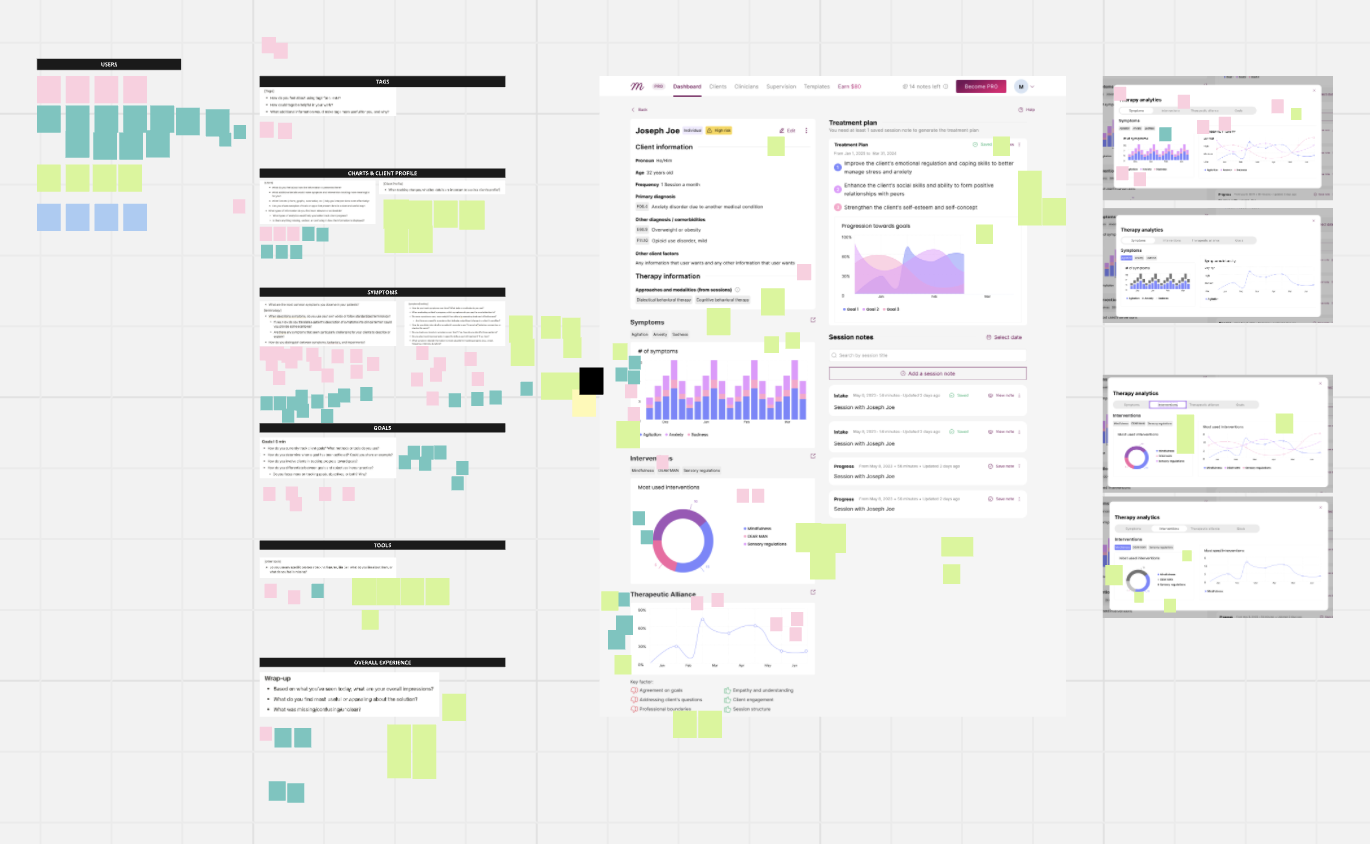
Research sessions produced rich affinity maps combining user insights, feature explorations, and UI concepts across symptoms, goals, tools, and therapeutic frameworks.
Discovery research board — therapeutic analytics explorationTogether these signals form the foundation of clinical reasoning in therapy.
Product Strategy
This discovery reframed the product opportunity.
Instead of positioning Mentalyc purely as an AI documentation assistant, the platform could evolve into an AI clinical co-pilot.
The system would analyze therapy conversations to surface three key signals:
- Alliance dynamics
- Symptom patterns
- Goal progress
AI documentation tool
Transcription, summaries, and automated notes — reducing admin burden but missing the clinical meaning behind conversations.
AI clinical co-pilot
A system that analyzes therapy conversations to surface alliance dynamics, symptom patterns, and goal progress — making therapy progress visible across sessions.
Defining the System
I led the design exploration translating these clinical frameworks into a product system.
The system analyzes therapy transcripts to detect conversational signals including:
- Therapist vs client speaking balance
- Emotional tone shifts
- Conversational interruptions
- Expressions of distress
- Emerging behavioral patterns
Each observation is supported by verbatim quotes from the session, allowing therapists to review the context behind the insight.
Transparency was essential to ensure clinicians trusted the system.
Key Product Decisions
Several strategic design decisions shaped the system.
Reflection Instead of Scoring
Early prototypes attempted to score therapeutic alliance.
Clinicians reacted negatively, describing scoring as reductive and incompatible with therapeutic practice.
We pivoted toward reflection-based feedback. Rather than evaluating therapists, the system surfaces conversational patterns that support therapist reflection.
Alliance Scoring
- • Quantifiable metrics
- • Easy comparison across sessions
- • Perceived as evaluating therapists
- • Incompatible with therapeutic practice
Reflective Insights ✓
- • Aligns with supervision culture
- • Supports reflection, not judgment
- • Less measurable
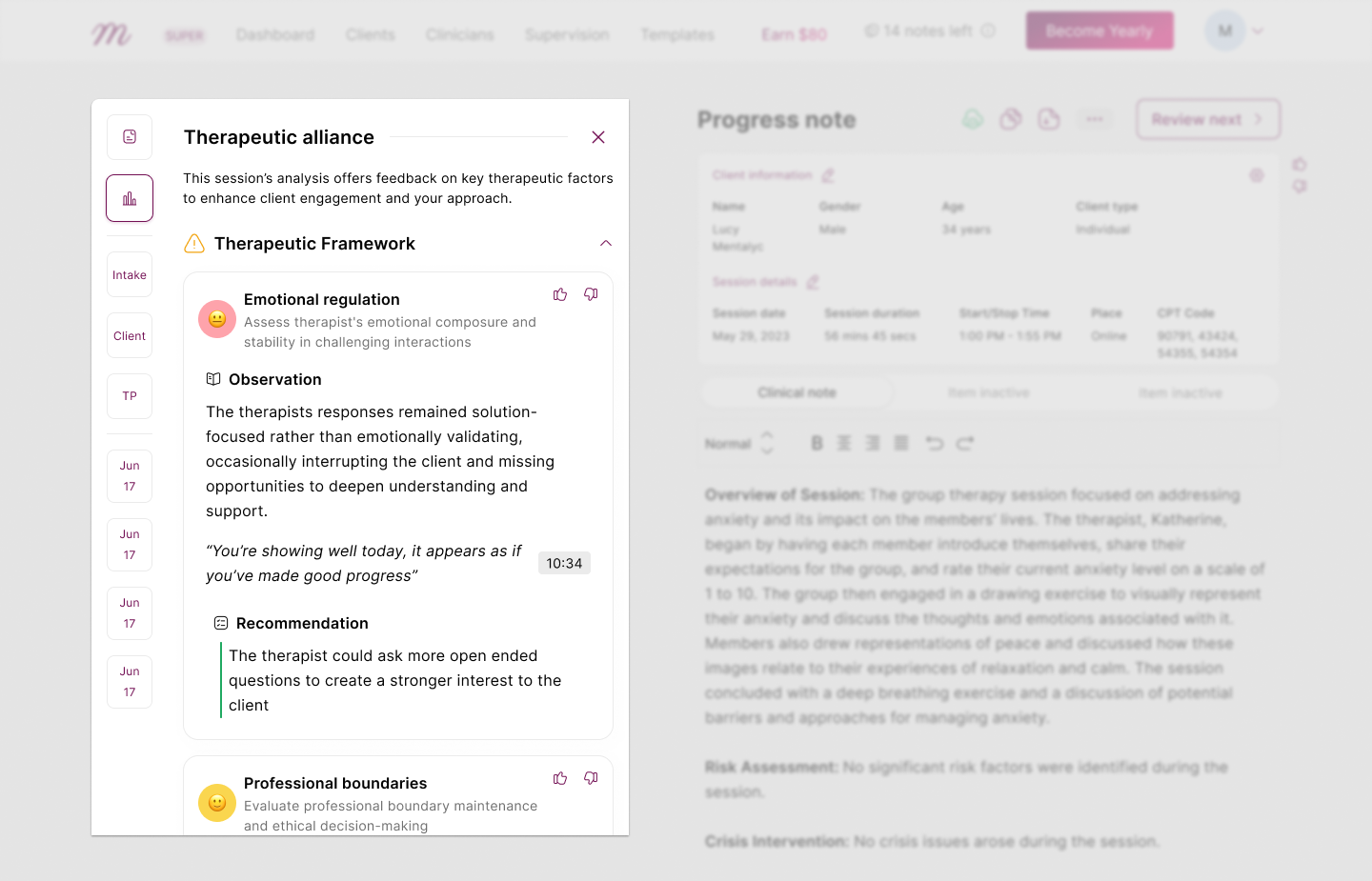
The Therapeutic Alliance panel surfaces AI observations about therapist-client dynamics, complete with verbatim quotes and actionable recommendations.
Therapeutic Alliance analysis panelSymptoms Instead of Diagnoses
Therapists rarely track progress through diagnostic labels. Instead they monitor symptoms and behavioral patterns.
Diagnoses are static, while symptoms evolve during treatment. We therefore shifted the system from diagnosis tracking to symptom detection.
DSM-5-TR Symptom Taxonomy
To enable symptom detection we analyzed DSM-5-TR diagnostic criteria and extracted a structured taxonomy of symptoms detectable in therapy conversations.
This allowed the system to surface signals such as:
- Recurring anxiety language
- Expressions of hopelessness
- Mood shifts
- Mentions of risk or self-harm
Connecting Symptoms to Goals
During discovery we found that therapy goals are frequently symptom-based or ability-based.
Examples include:
- Reducing anxiety symptoms
- Improving emotional regulation
- Decreasing avoidance behavior
By linking symptom signals to treatment goals, the system could track therapy progress across sessions.
Product Experience
Insights were integrated directly into the therapist workflow after each session.
Clinical Insight Panel
AI observations supported by session quotes.
Session Timeline
Markers highlighting key conversational dynamics within the session.
Therapeutic Alliance Feedback
Reflection prompts helping therapists strengthen the therapeutic relationship.
Client Progress Dashboard
A client-level dashboard showing symptom trends, treatment goal progress, and alliance signals across sessions — allowing therapists to visualize therapy progress over time.
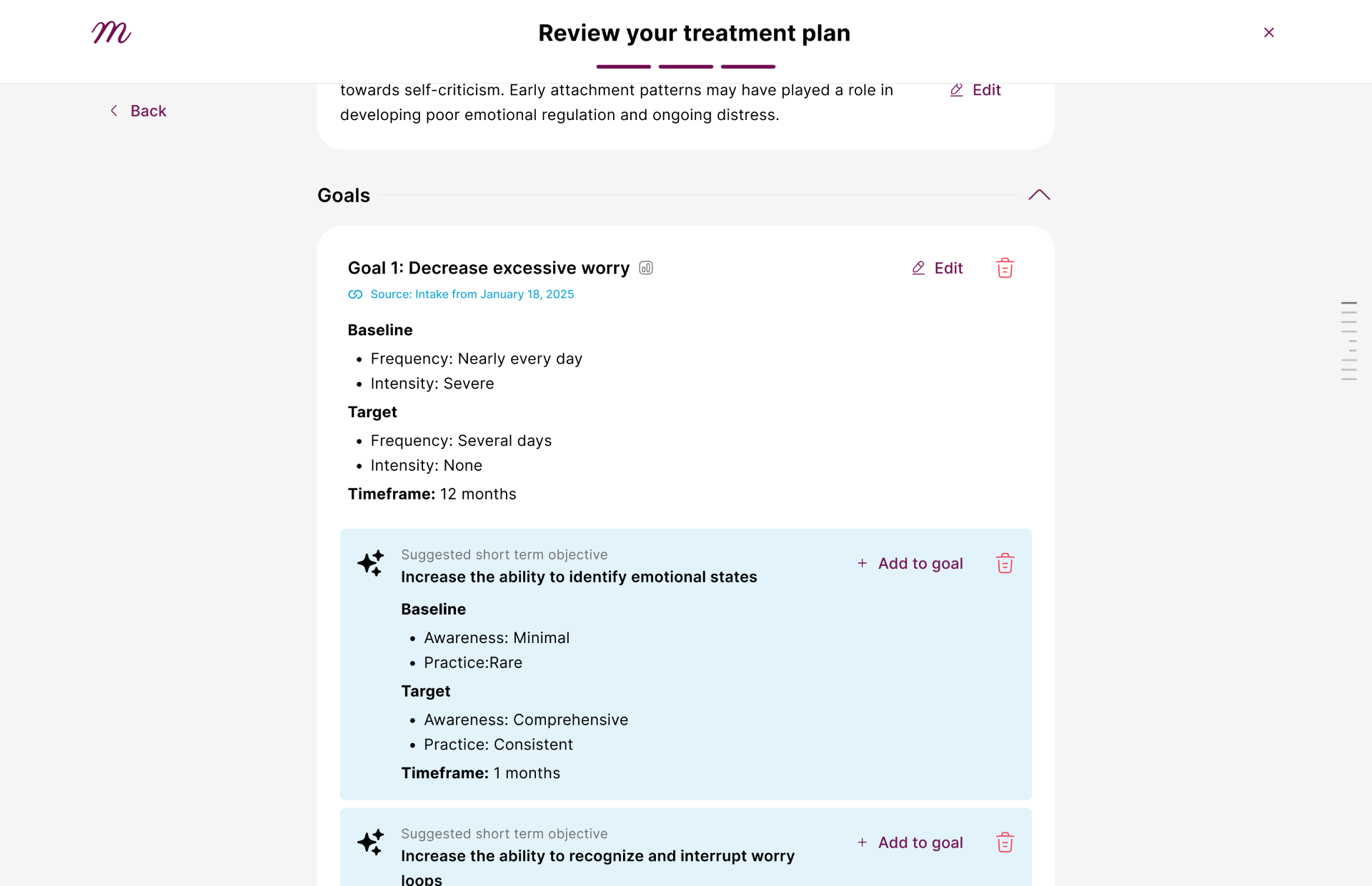
Treatment plans evolved into structured, goal-oriented workflows with AI-suggested short-term objectives linked to clinical baselines and targets.
Treatment plan review with AI-suggested objectives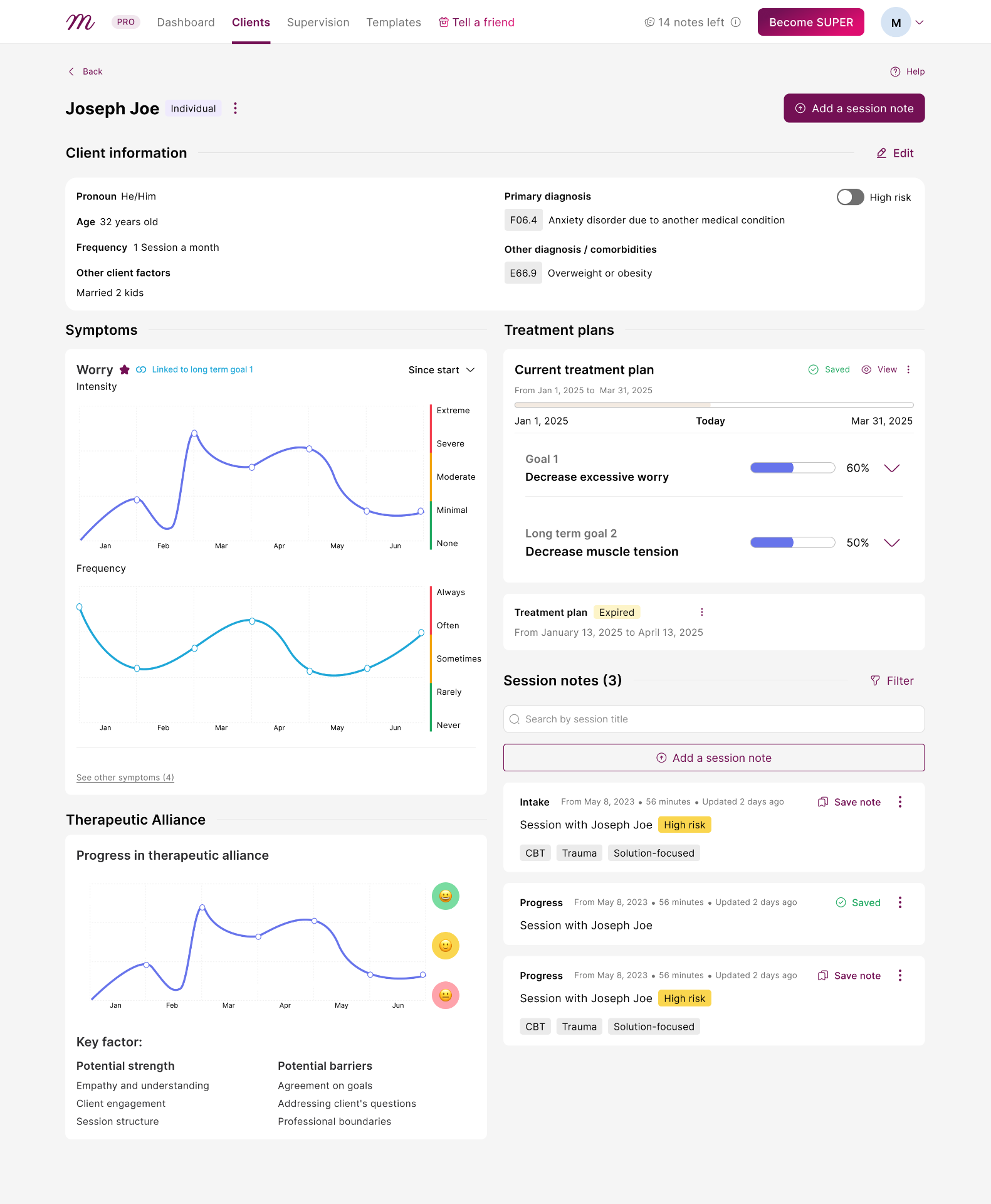
The unified client dashboard brings together symptom trends, therapeutic alliance scores, treatment plan progress, and session history — giving therapists a complete clinical picture at a glance.
Client Progress Dashboard — symptom tracking and treatment progressImpact
The project introduced a new clinical insight layer connecting therapy conversations, symptom signals, and treatment goals.
Rather than simply generating documentation, the system enabled therapists to reflect on sessions and track progress across treatment.
Strong Engagement with Insight Feedback
During pilot testing, clinicians actively engaged with the insight system. Therapists:
- Rated AI observations
- Reviewed supporting session quotes
- Provided feedback that refined the system
"It feels a bit like having a supervisor reviewing your session and pointing out things you might want to try differently."
Early-career clinicians used the insights as a structured reflection tool, while experienced therapists used them as an additional lens for reviewing sessions.
"I had a client with strong narcissistic traits and kept hitting a wall trying to build alliance. The AI flagged moments where the interaction had stalled and suggested shifts in my approach. I tried them in the next session — he became noticeably less defensive, and I was finally able to start building real rapport."
Making Therapy Progress Visible
By linking symptom patterns, treatment goals, and alliance signals, the system helped therapists understand how therapy was evolving over time.
Clinicians reported that symptom signals were often more meaningful than diagnoses, because they reflected how clients were actually changing across sessions.
Goal tracking became one of the most highly rated features during validation.
Strategic Product Shift
AI documentation tool
The original product positioning focused on reducing administrative burden through automated note generation.
AI clinical insight platform
The insight system created the foundation for AI-assisted supervision, measurement-based care, therapy progress analytics, and early risk detection.
Industry Recognition & Product Launch
The clinical insight framework was presented at the Evolution of Psychotherapy Conference in Los Angeles, CA, where it generated strong interest from clinicians exploring AI-assisted supervision and reflection tools.
The framework shipped as two public products. Alliance Genie launched in September 2025 as the first AI tool to measure therapeutic alliance directly from session recordings, analyzing over 30 psychosocial markers to provide structured reflective feedback that mirrors an experienced clinical supervisor. The AI Progress Tracker followed in December 2025, automatically surfacing symptom trends and goal attainment across sessions without additional clinician work.
Together, these products turned the alliance-symptom-goal framework described in this case study into a publicly available clinical insight system, validating both the strategic direction and the design decisions behind it.
My Contribution
As Product Strategy & Design Consultant, I:
- Shaped the strategic direction toward AI clinical insights
- Translated research findings into the alliance-symptom-goal framework
- Designed the system architecture for generating clinical signals
- Led prototyping and validation with clinicians
- Designed the UX for surfacing insights within therapist workflows
Key Takeaways
Designing AI for clinical practice revealed several important principles.
Insight is welcomed, evaluation is resisted
Clinicians are open to AI-generated reflection but strongly reject performance scoring.
Transparency builds trust
Providing session quotes alongside insights helped therapists understand and trust the system.
Therapy conversations contain signals traditional tools miss
AI analysis of session dialogue can reveal patterns that standardized questionnaires alone cannot capture.
Building something in mental health?
Whether you want a product partner, a second opinion, or just to compare notes between builders — I'd love to hear what you're working on.